Warehouse putaway refers to the process of placing goods that have entered the warehouse (e.g., via purchase, transfer, or return) into their designated storage locations. It is the final step in the inbound process. While putaway may seem like simply placing items onto shelves, the logic behind it is quite complex – which brings us to putaway strategies.
Putaway strategy is one of the core functions of a Warehouse Management System (WMS), directly impacting subsequent picking efficiency, inventory management, and space utilization. Choosing the right strategy is crucial. Below we introduce several mainstream putaway strategies. Below, we introduce several mainstream warehouse putaway strategies, the key benefits of getting them right, and best practices to help you optimize your operations.
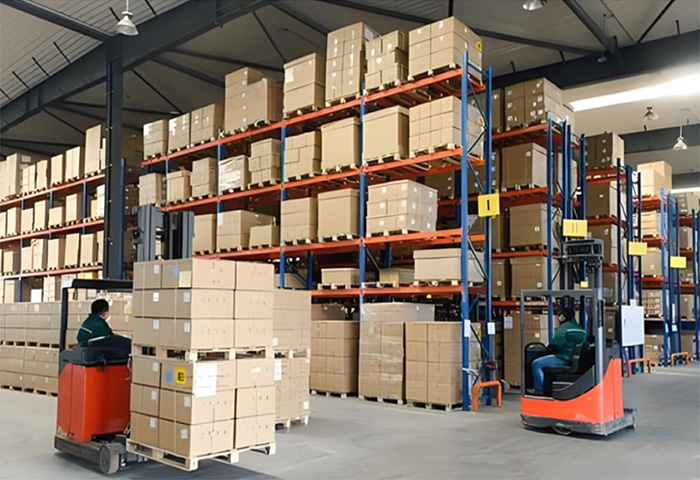
This is the most common, traditional, and simplest warehouse putaway method.
Core Idea:
Each product is assigned a fixed, dedicated storage location. Whenever goods are received, they are placed only in this designated spot, regardless of whether other locations may be more convenient at the time. This approach is often used in small warehouses with a limited and stable product variety, where the predictability of fixed locations outweighs the flexibility of dynamic alternatives.
Advantages & Disadvantages:
Applicable Scenarios:
Also known as the "floating location strategy," this is one of the fundamental strategies in modern WMS.
Core Idea:
Goods can be stored in any empty location that meets their storage requirements (e.g., temperature, weight capacity). The system tracks each item's location to manage inventory.
Advantages & Disadvantages:
Applicable Scenarios:
This is a compromise and optimization between fixed and random strategies, and one of the most commonly used and effective approaches in mature warehouses.
Core Idea:
Divide storage zones and use random storage within each zone. The most common classification method is ABC analysis, based on criteria such as sales value, shipping frequency, or volume.
Advantages & Disadvantages:
Applicable Scenarios:
As the name implies, this strategy follows a proximity principle, also referred to as "adjacent location storage."
Core Idea:
The system recommends the nearest available and suitable empty location relative to the current operation point (e.g., receiving dock or picker's current position) for putaway.
Advantages & Disadvantages:
Applicable Scenarios:
There is no single "best" strategy – the choice depends on specific business needs. Key factors to consider include:
Summary:
No single strategy fits all scenarios. Successful warehouse operators flexibly apply and combine these strategies based on their unique business needs and continuously optimize as the business evolves. For most modern warehouses, a class-based storage strategy using ABC analysis is often the best starting point for balancing efficiency and cost. The table below summarizes the key aspects of each strategy for comparison:
| Strategy Name | Core Idea | Advantages | Disadvantages | Applicable Scenarios |
| Fixed Location | One product, one fixed location | Simple management, easy to remember | Low space utilization, inflexible | Few, stable SKUs; large items |
| Random Location | Any empty slot can be used | Highest space utilization, flexible | System-dependent; messy picking paths | Many, volatile SKUs; with WMS |
| Class-based(ABC) | Zoen by importance, random within zone | Optimizes picking, balances efficiency | Requires periodic category analysis | Most warehouses following 80/20 rule |
| Nearest Location | Recommends closest empty slot | Reduces putaway travel time | May disrupt overall layout optimization | Supplementary to random/class-based |
Popular Keywords: Pallet Jack Robot , Stacker Crane