In intelligent bin-based warehouse storage scenarios, faced with massive SKUs, high-frequency inbound and outbound operations, and continuously rising land costs, high-density and high-efficiency automated bin storage solutions have become the industry mainstream.
Bin robots, four-way shuttle carts, and miniload stackers are the three core automated bin storage and retrieval systems currently available on the market.
Although they employ different technologies and have distinct performance characteristics, together they define the structure of modern bin warehouses.
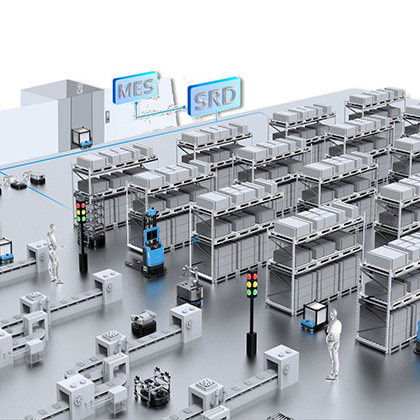
For planners, one of the biggest challenges is deciding how to choose around the critical height threshold of 20 meters.
Selection starts with a deep understanding of the technical principles and capabilities of each type of equipment.
The core model is "shelf-to-person." The robot moves along the aisle, lifts directly to the target location, picks one or multiple bins using a telescopic fork or platform, and transports them to the picking workstation at the end of the aisle.
The main advantages are high flexibility and scalability: deployment is relatively simple, adaptable to various sites, and system capacity can be linearly adjusted by adding or removing robots. Suitable for businesses with fluctuating demands or phased investments.
However, the single-machine full-process operation may become a bottleneck when extreme throughput is required.
The next-generation robot builds on the CTU concept and achieves significant breakthroughs.
STU features a dual-stage telescopic lifting mechanism, with travel speed up to 3 m/s and lift speed 2 m/s, achieving pick-and-place in under 3 seconds for higher efficiency.
Its innovative design surpasses the traditional 12-meter height limitation, enabling applications in warehouses above 20 meters.
This allows STU to maintain CTU’s flexibility while adapting to higher and denser storage needs, with some high-end systems supporting up to 24 meters, providing new flexible automation options for medium-to-high warehouses.
The system consists of racks, four-way shuttles, lift units, sorting systems, and software.
The shuttle moves freely along horizontal and vertical tracks, coordinating with lifts for layer changes. Racks provide dense storage; shuttles handle horizontal transport, lifts handle vertical transport, forming a relay for storage and retrieval.
Core advantages include excellent parallel operation capability and extremely high storage density. Multiple shuttles and lifts can operate simultaneously, and throughput can scale almost linearly with equipment addition.
The system typically includes racks, conveyors, stackers, and software, with the stacker as the core device.
Miniload operates at high speed along fixed aisles, with forks designed for fast, precise bin handling.
Key advantages are high single-machine efficiency and reliability. Fixed paths guarantee short cycle times, and mature technology ensures dependable operation. Performance improvements depend on lift speed and acceleration, as well as double-depth storage designs to increase per-cycle handling.
CTU/STU: High system flexibility
Four-way shuttle: High parallel capability and storage density
Miniload: High single-machine efficiency, mature and reliable
Selection should align equipment capabilities with project requirements. Key dimensions include:
Warehouse height can be categorized as below 20 metersor above 20 meters.
All three types can be deployed; selection should match business needs.
CTU/STU (Below 12 meters)
Four-Way Shuttle
Miniload
Simplified Decision Logic:
Above 20 meters usually means large-scale projects, high investment, and a need for higher density and throughput.
Common Challenges:
Four-Way Shuttle Advantages:
Miniload Advantages:
STU Breakthrough Application:
Extreme Scenario (100,000+ SKUs, e-commerce peak, above 20 meters):
Hybrid solutions (e.g., Four-way Shuttle + Miniload or STU + Miniload) may emerge, using different equipment in different zones to balance overall density and local peak efficiency.
Conclusion:Understanding business requirements and equipment characteristics is key to making the smartest decisions for automated bin storage warehouses.
Popular Keywords: Pallet Jack Robot , Stacker Crane